How the Tahoe Basin Design Review Committee examined the project’s scale, circulation, housing, and development standards during a three-hour public review.
Introduction
On February 24, the proposed 39° North redevelopment underwent one of its most detailed public design discussions to date, as the Tahoe Basin Design Review Committee spent more than three hours examining the project’s scale, circulation, housing, and relationship to the planning framework guiding redevelopment in Kings Beach’s Town Center district.
The meeting came at a significant moment in the project’s timeline. Under the Fourth Amendment to the development agreement between Placer County and the developer, environmental documentation for the project is expected to be submitted for review in March 2026.
During the meeting, County staff also indicated that the project may proceed through Tahoe Basin Area Plan (TBAP) conformity review rather than a separate project-level environmental review. That distinction matters because the two pathways evaluate projects differently and may shape how environmental impacts are analyzed, what alternatives are considered, and how public review occurs as the proposal moves toward approval.
Against that backdrop, the committee’s discussion offered an early look at how the project is currently being examined within the planning framework guiding redevelopment in Kings Beach’s Town Center district.
While the Tahoe Basin Design Review Committee does not approve projects, its feedback often shapes how proposals evolve before formal hearings occur.
This article is based on the February 24, 2026 Tahoe Basin Design Review Committee meeting and presentation materials shared during that session.
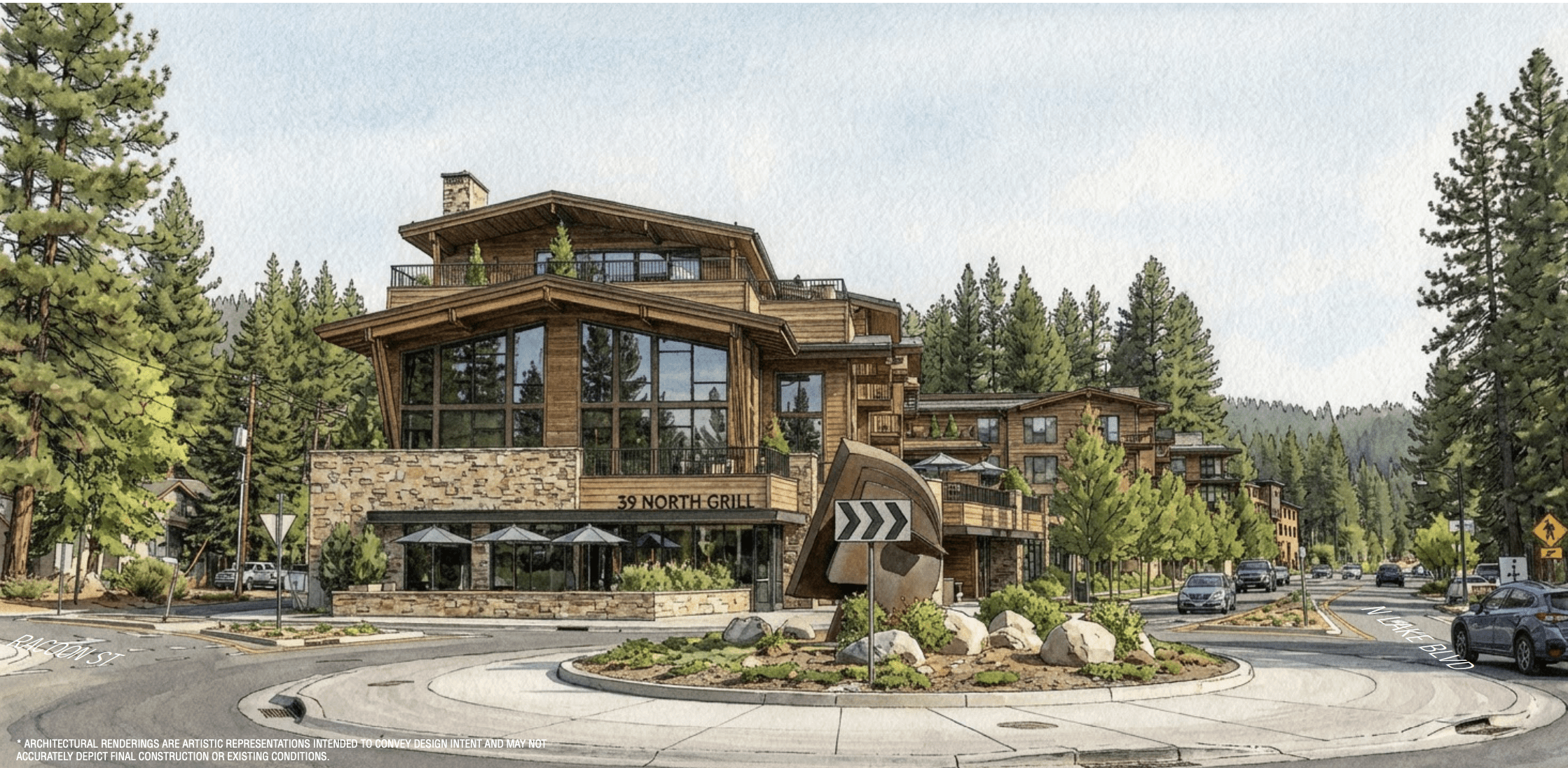
Project Snapshot: 39° North Proposal
Location
Kings Beach Town Center area, North Lake Tahoe
Developer
Kingsbarn Capital & Development
Three Project Components
Hotel / Commercial Building
• 132-room hotel
• ground-floor retail and restaurant space
• located along North Lake Boulevard near the Raccoon Street roundabout
Condo-Hotel Townhomes
• 38 market-rate townhomes participating in a hotel rental program
• located along Salmon Avenue
Achievable Housing
• 64 deed-restricted achievable apartments
• located on a separate parcel near North Lake Boulevard and Chipmunk Street
Total Program
• 234 total units/keys across two Town Center redevelopment sites
Key Design Elements
• approximately 445-foot hotel building length
• structured parking podium with 181 spaces
• ground-floor commercial frontage along North Lake Boulevard
• internal pedestrian paseos connecting streets through the site
Current Status
• Preliminary informational review before the Tahoe Basin Design Review Committee
Next Milestone
• Submission of environmental documentation expected March 2026
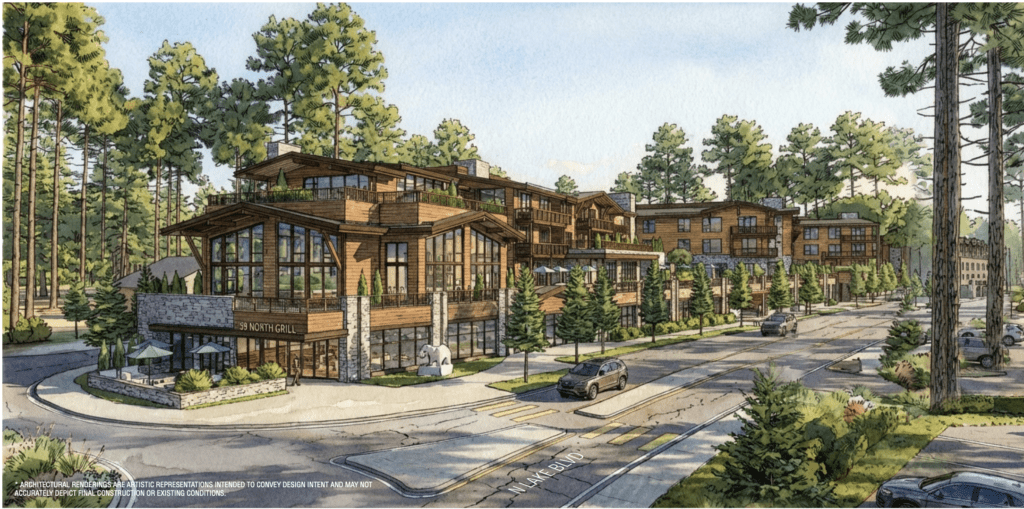
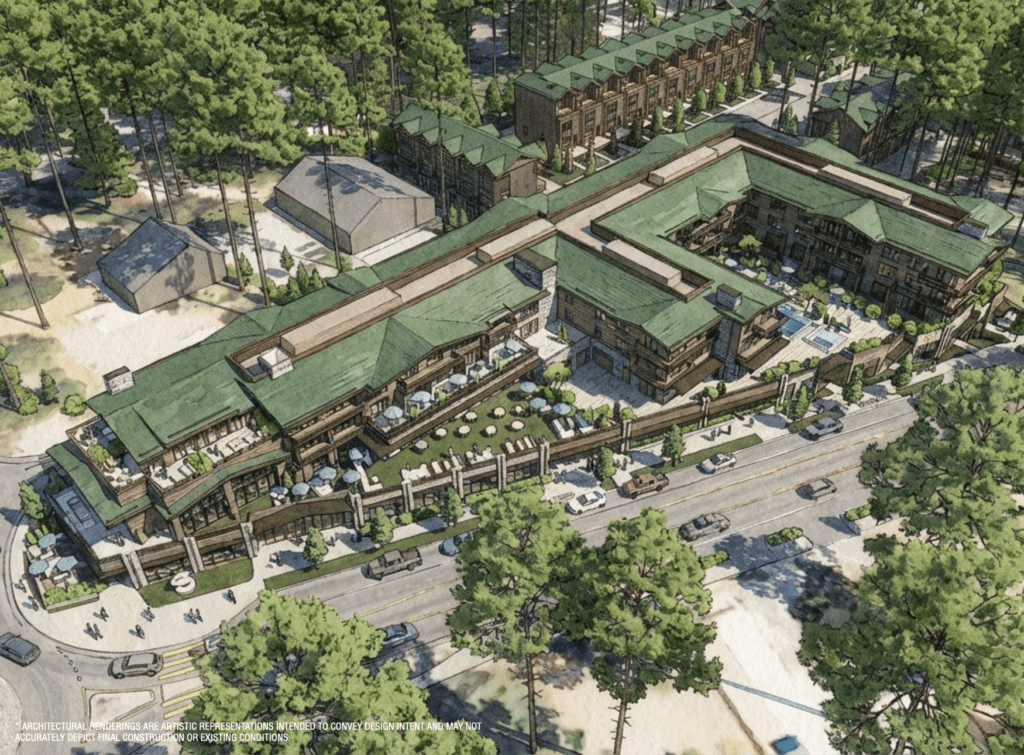
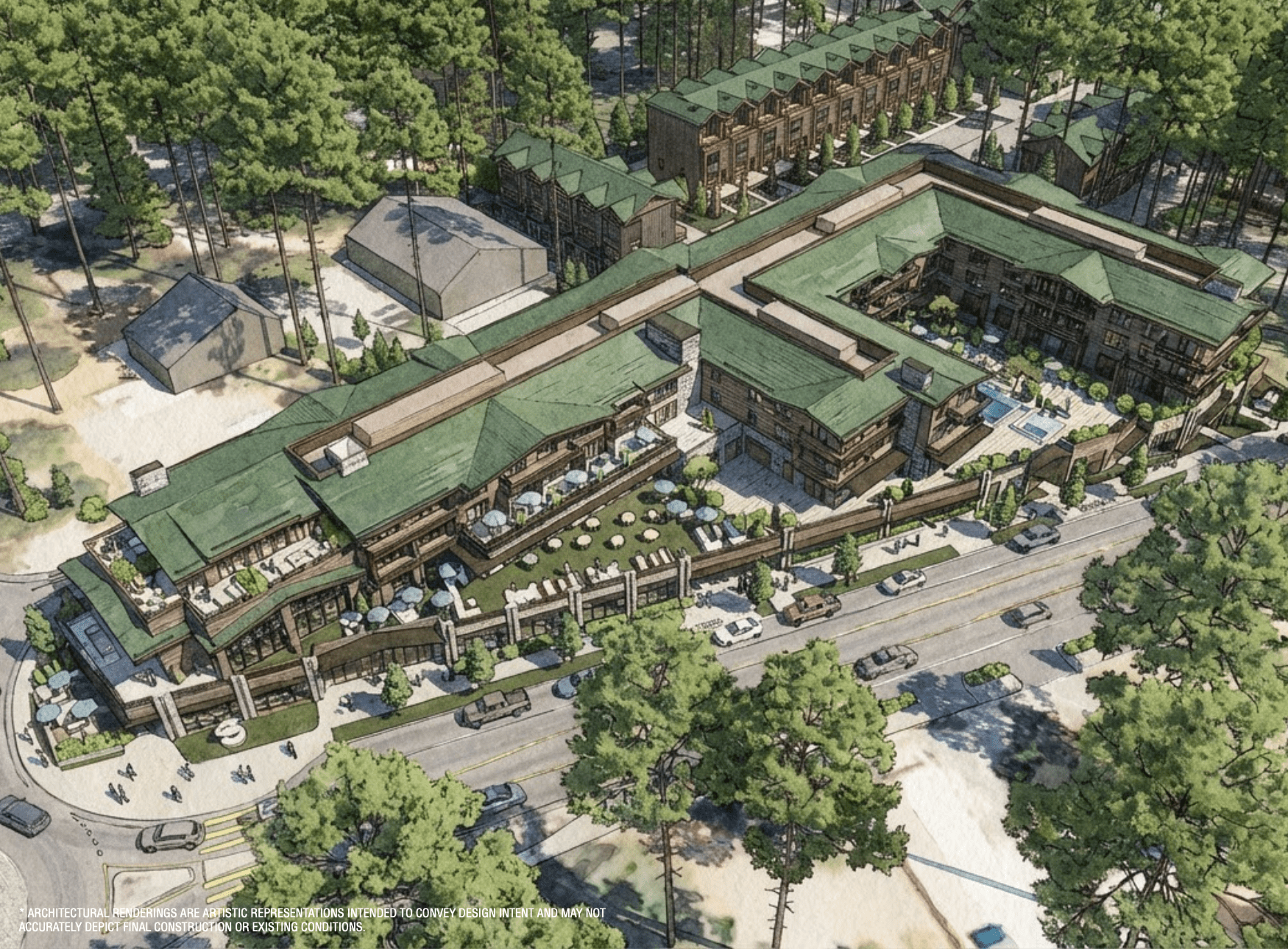
Rendering of the proposed hotel and commercial frontage along North Lake Boulevard.
County Presentation: How the Review Process Works
The February 24 meeting opened with a presentation from Placer County planning staff, who provided an overview of the project and the role of the Tahoe Basin Design Review Committee in the broader approval process.
County staff explained that the design review committee serves as an advisory body composed of community members representing disciplines such as architecture, construction, and local business. The committee reviews projects for consistency with development and design standards contained within the Tahoe Basin Area Plan and provides recommendations before projects advance to decision-making bodies.
Because the 39° North proposal is a large redevelopment project with multiple components, staff described the February meeting as an informational review intended to introduce the committee to the latest project design and gather preliminary feedback.
No vote or formal recommendation was scheduled.
Instead, comments from the committee would help guide revisions before the project returns to the design review committee for a future recommendation hearing.
County staff also outlined the broader permitting process for the proposal.
The project will ultimately require review by the Placer County Planning Commission, which serves as the primary decision-making body for the project’s permits, including the conditional use permit, design review approval, and other development entitlements associated with the proposal.
Following County approvals, the project would also require review by the Tahoe Regional Planning Agency Governing Board.
During the presentation, staff explained that once the project’s final application is submitted and deemed complete, preparation of the environmental review document would begin, with environmental analysis expected to start in 2026.
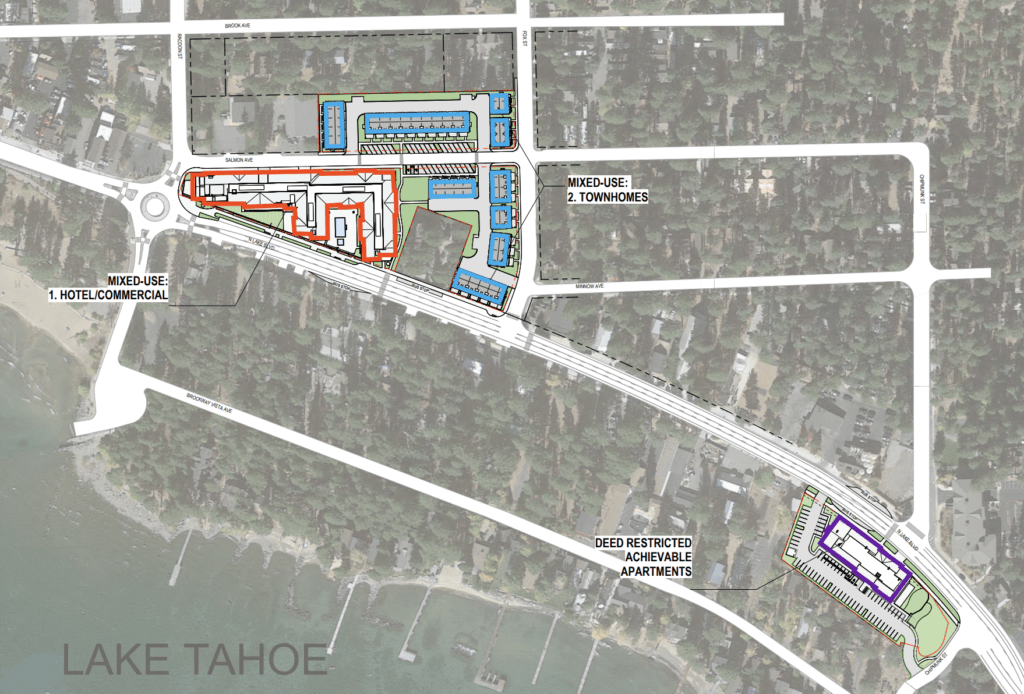
Site plan illustrating the hotel/commercial site near the Raccoon Street roundabout and the separate achievable housing parcel near Chipmunk Street.
Following the County’s overview of the process and project timeline, the meeting then turned to the applicant team, who presented the latest design and program for the proposed redevelopment.
Developer Presentation: Introducing the 39° North Proposal
Following the County’s overview of the review process, representatives for the development team presented the latest design and program for the proposed 39° North redevelopment.
The project is being proposed by Kingsbarn Capital & Development, with architectural design led by OZ Architecture, a Denver-based firm working with the developer on the current proposal.
During the presentation, the applicant team described the project as a mixed-use redevelopment intended to introduce new visitor accommodations, commercial activity, and housing within the Kings Beach Town Center area.
The proposal brings together three primary components across two separate sites within the district.
The largest portion of the project is a hotel and commercial building located along North Lake Boulevard near the Raccoon Street roundabout, one of the primary gateways into Kings Beach’s commercial core. The proposed hotel would include 132 guest rooms, along with ground-floor retail and restaurant space designed to activate the street frontage along the highway corridor.
The building is organized around a structured parking podium, which would accommodate approximately 181 parking spaces across two levels within the base of the development.
In addition to visitor accommodations, the proposal includes 38 condo-hotel townhomes located along Salmon Avenue, behind the main hotel structure. These units would be individually owned but participate in a hotel rental program, allowing them to function as visitor accommodations when not occupied by their owners.
A third component of the proposal introduces 64 achievable housing apartments, which are proposed on a separate parcel farther east along North Lake Boulevard near Chipmunk Street.
Although the housing site is not physically connected to the hotel and townhome site, the proposal is being reviewed as a single mixed-use development across two noncontiguous parcels within the Town Center district.
During the presentation, the development team emphasized that the design attempts to balance visitor accommodations, housing, and commercial uses while responding to development standards within the Town Center planning framework.
Several architectural strategies were described as part of that approach, including the use of pedestrian paseos connecting interior courtyards to surrounding streets and façade articulation intended to break down the perceived scale of the hotel building along North Lake Boulevard.
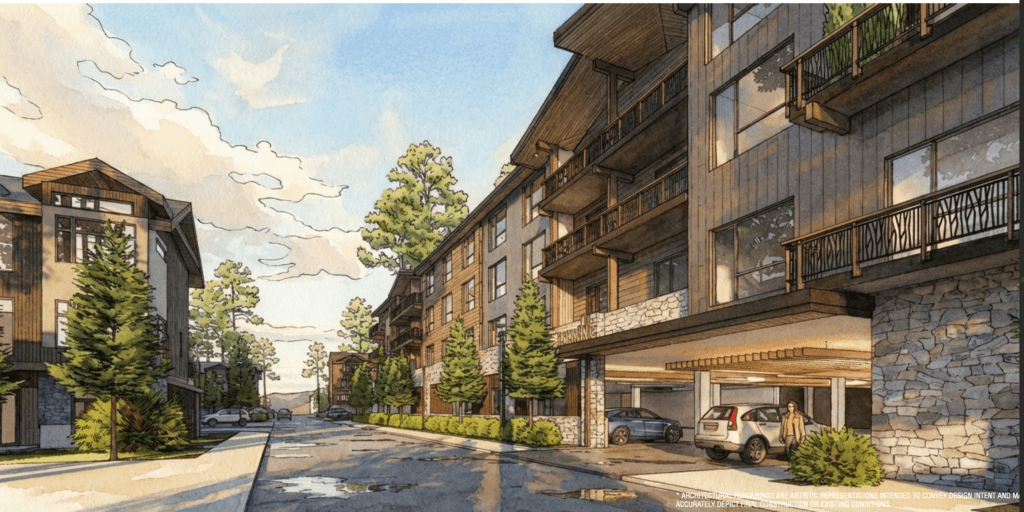
Rendering showing internal pedestrian connections linking North Lake Boulevard and Salmon Avenue.
With the project overview established, the discussion then shifted toward the broader planning framework that guides redevelopment within Kings Beach’s Town Center.
Understanding that framework provides important context for the questions that emerged during the committee’s review.
The Town Center Vision That Set the Yardstick
Redevelopment of the Kings Beach Center and Eastern Gateway properties was never intended to function as a stand-alone project.
For more than a decade, planning efforts in Kings Beach have focused on creating a walkable Town Center district organized around active streets, mixed-use buildings, and public gathering spaces.
Those goals are reflected in two key planning documents:
• Kings Beach Vision Plan (2013)
• Tahoe Basin Area Plan
Together, these documents established the framework for redevelopment in the Town Center district, emphasizing:
- walkable streets and connected blocks
- buildings scaled to a village-style environment
- active ground-floor uses that support local businesses
- public spaces that contribute to the life of the community
Within that framework, the Kings Beach Center and Eastern Gateway properties have long been identified as central redevelopment sites capable of anchoring the Town Center district.
Development on these parcels is therefore expected to do more than simply replace existing structures. It plays an important role in shaping how the Town Center functions — influencing how buildings frame the street, how pedestrians move through the district, and how public activity unfolds at ground level.
The Tahoe Basin Area Plan also includes design and development standards intended to guide how larger buildings fit within the district.
Those standards address elements such as:
- building height and length
- architectural articulation and façade variation
- pedestrian connectivity through development sites
- relationships between buildings and surrounding streets
Together, these policies establish the yardstick against which redevelopment proposals in the Town Center district are evaluated.
With that planning framework in mind, members of the Tahoe Basin Design Review Committee began examining how the latest version of the 39° North proposal fits within those expectations.
The discussion that followed explored a series of questions about building scale, street activity, housing placement, and how development standards should be interpreted as the project moves forward. Several of those questions centered on how the proposed hotel building — the largest element of the redevelopment — fits within the Town Center’s intended block pattern.
1 — How Does a 445-Foot Building Fit the Town Center Pattern?
One of the first issues to draw sustained discussion from committee members was the length of the proposed hotel building.
As presented, the structure extends roughly 445 feet along North Lake Boulevard, making it one of the longest buildings currently proposed within the Kings Beach Town Center district.
Town Center planning guidance generally anticipates building segments closer to 250 feet — a scale intended not only to reflect a village-style block pattern, but also to preserve light, air, and a pedestrian rhythm along the street.
These standards are designed so that, as people move along a sidewalk, buildings are experienced as a sequence of smaller structures, with frequent entrances, storefronts, and visual breaks.
The discussion focused on how the proposed building would actually be experienced at that scale.
Would it read as a series of smaller buildings arranged along the block — or as a single continuous structure extending nearly the full length of the frontage?
Can Architectural Articulation Break Down the Building?
The project’s design team described several techniques intended to reduce the perceived scale of the building, including changes in façade materials, stepped building volumes, vertical breaks in the massing, and variation along the frontage.
These strategies are commonly used in larger developments to create the appearance of multiple buildings rather than a single continuous structure.
Committee members, however, returned to a more practical question: whether those techniques change how the building looks — or how it functions.
From the perspective of someone walking along North Lake Boulevard, would the building feel like a sequence of smaller structures, or would it still read as a continuous wall of development along the street?
When Parking Shapes the Architecture
Another factor influencing the building’s form became clearer during the discussion.
The hotel is organized above a structured parking podium, which establishes much of the building’s footprint and internal layout.
Because the parking structure forms the base of the development, it also influences where entrances are located, how circulation is arranged, and how the building meets the street.
Committee members noted that when parking drives the organization of a project, it can shape architectural decisions in ways that affect how the building engages with the pedestrian environment.
Several members encouraged the design team to continue examining how the podium configuration influences the relationship between the building and the street — including how entrances, storefronts, and pedestrian routes are organized along the frontage.One of the first issues to draw sustained discussion from committee members was the length of the proposed hotel building.
As presented, the structure extends roughly 445 feet along North Lake Boulevard, making it one of the longest buildings currently proposed within the Kings Beach Town Center district.
Town Center planning guidance generally anticipates building segments closer to 250 feet — reflecting the smaller block pattern typical of village-scale environments. These standards are intended to maintain a pedestrian rhythm along streets, where building façades, entrances, and storefronts appear at intervals that feel comfortable to people walking along the sidewalk.
The discussion focused on how the proposed building would be experienced from the street.
Would the structure read as one long building, or could architectural design strategies allow it to feel like a series of smaller buildings arranged along the block?
Can Architectural Articulation Break Down the Building?
The project’s design team described several techniques intended to reduce the perceived scale of the building.
These included:
- changes in façade materials
- stepped building volumes
- vertical breaks in the building mass
- varied architectural elements along the frontage
Together, these strategies are often used in larger developments to create the visual impression of multiple buildings rather than a single continuous structure.
Several committee members returned to a practical question: how those techniques would actually translate at the pedestrian level.
From the perspective of someone walking along North Lake Boulevard, would the building feel like a sequence of smaller structures, or would it still read as a continuous wall of development along the street?
When Parking Shapes the Architecture
Another factor influencing the building’s design became clearer during the discussion.
The hotel sits above a structured parking podium, which organizes much of the building’s footprint and circulation.
Because the parking structure forms the base of the development, it also influences how entrances are positioned and how the building’s mass is arranged above the ground level.
Committee members noted that when parking structures shape the layout of a project, they can sometimes drive architectural decisions that affect how the building engages with the surrounding pedestrian environment.
Several members encouraged the design team to continue examining how the podium configuration affects the building’s relationship to the street — including how entrances, storefronts, and pedestrian routes are organized along the frontage.
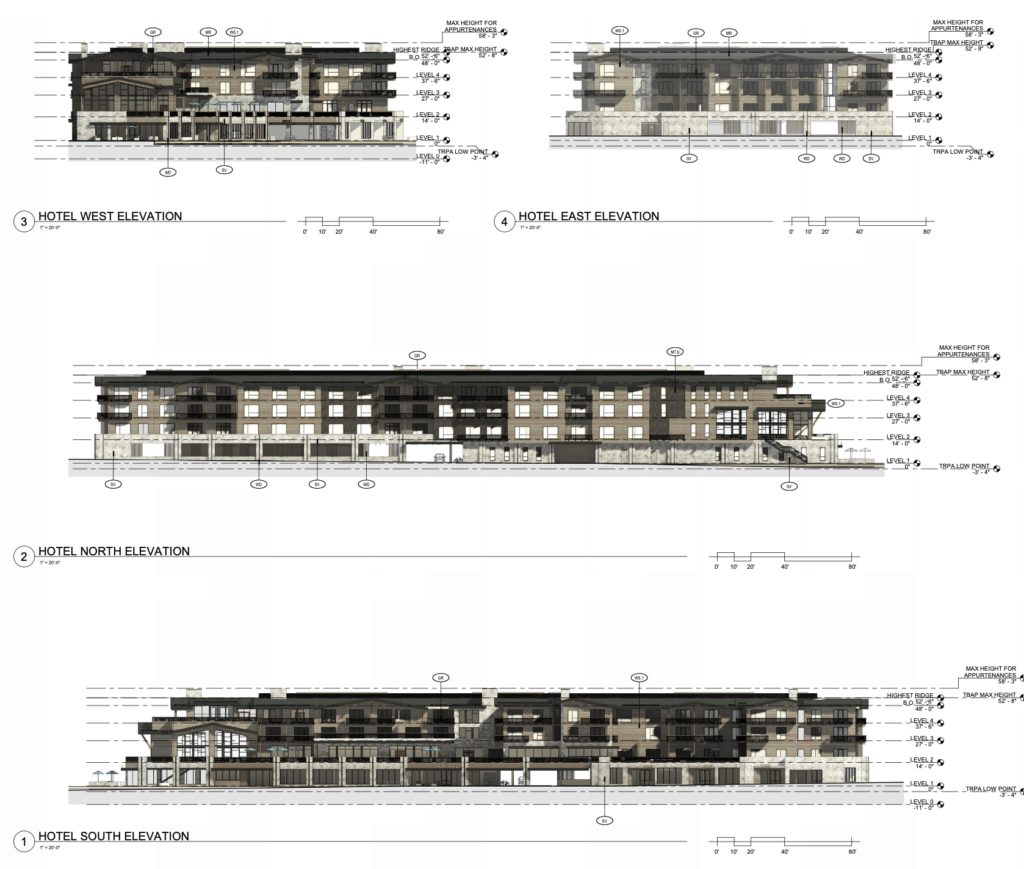
Elevation diagram illustrating the full length of the proposed hotel building along North Lake Boulevard.
2 — Does the Site Function as a Connected Town Center Block — or an Internal Development?
Beyond the architecture of the hotel building itself, committee members also examined how the overall site is organized — and how people would move through the development.
A central question emerged: whether the project functions as an extension of the Town Center street network, or whether activity is primarily organized within the project itself.
Parking and Site Organization
Because the hotel sits above a large structured parking podium, much of the site’s circulation is organized around internal access points connected to that structure.
This arrangement influences where vehicles enter the site, how pedestrians move through the block, and how the development connects to surrounding streets.
Committee members noted that projects organized around large parking structures can sometimes become inward-facing — with activity concentrated within internal courtyards and circulation routes rather than along public streets.
The design team described efforts to address that condition through pedestrian pathways and ground-floor uses intended to connect the project to the surrounding Town Center.
Circulation Through the Block
The proposal includes pedestrian paseos intended to allow movement through the site between North Lake Boulevard and Salmon Avenue.
These interior walkways would connect public sidewalks to internal courtyards and gathering spaces within the development.
Committee members asked how visible and intuitive those routes would be to people moving along the street.
Would pedestrians recognize these passages as public connections through the block — or would they read as private pathways primarily serving hotel guests and residents?
The distinction reflects a broader question about how the site functions.
Does the project extend the public life of the Town Center into the block — or does it draw activity inward, organizing it within internal spaces that are less connected to the surrounding streets?
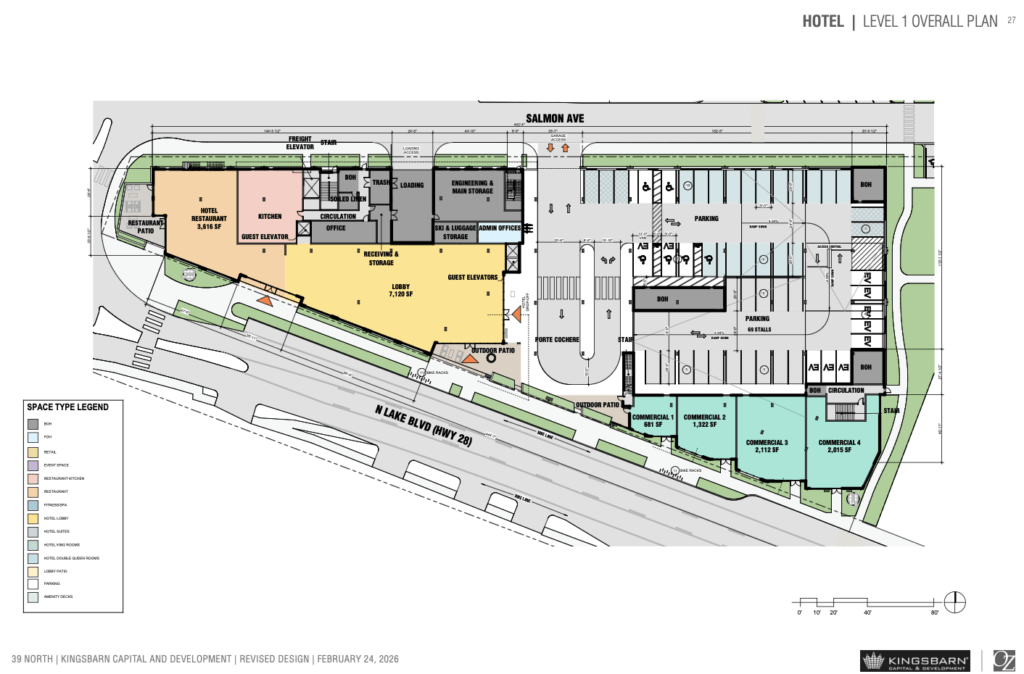
Diagram illustrating proposed pedestrian connections linking North Lake Boulevard and Salmon Avenue.
3 — Will Activity Spill Onto the Street — or Stay Inside the Project?
Closely related to the discussion about circulation was another question raised by committee members: where the activity generated by the project would actually occur.
The proposal includes ground-floor retail and restaurant spaces along North Lake Boulevard, intended to activate the street frontage.
Committee members examined how those spaces are distributed and how they would function at the pedestrian level — including where entrances are located, how storefronts face the sidewalk, and whether the scale and placement of commercial uses are sufficient to create a continuous, active street edge.
Ground-Floor Commercial Presence
While the project introduces commercial uses along the frontage, members questioned whether the amount and arrangement of those spaces would generate consistent street-level activity.
In Town Center environments, storefronts, entrances, and visible activity along the sidewalk play a central role in shaping how people move through a district.
The discussion focused on whether the proposed frontage would function as an active, engaging streetscape — or whether activity would be more limited or intermittent along the block.
When Activity Moves Inside
As the design team described interior courtyards, gathering spaces, and event areas within the development, another pattern became clearer.
Much of the project’s programmed activity appears to be organized within internal spaces rather than along the public street frontage.
That prompted a broader question about how the project would function during everyday use.
Would activity generated by the hotel, restaurants, and shared spaces spill outward into the surrounding Town Center streets — or remain concentrated within internal courtyards and areas primarily serving guests and residents?
The distinction reflects a core question about the role the project plays within the Town Center.
Whether activity is visible and accessible from the street — or primarily internal — can shape how the development contributes to the public life of the district.
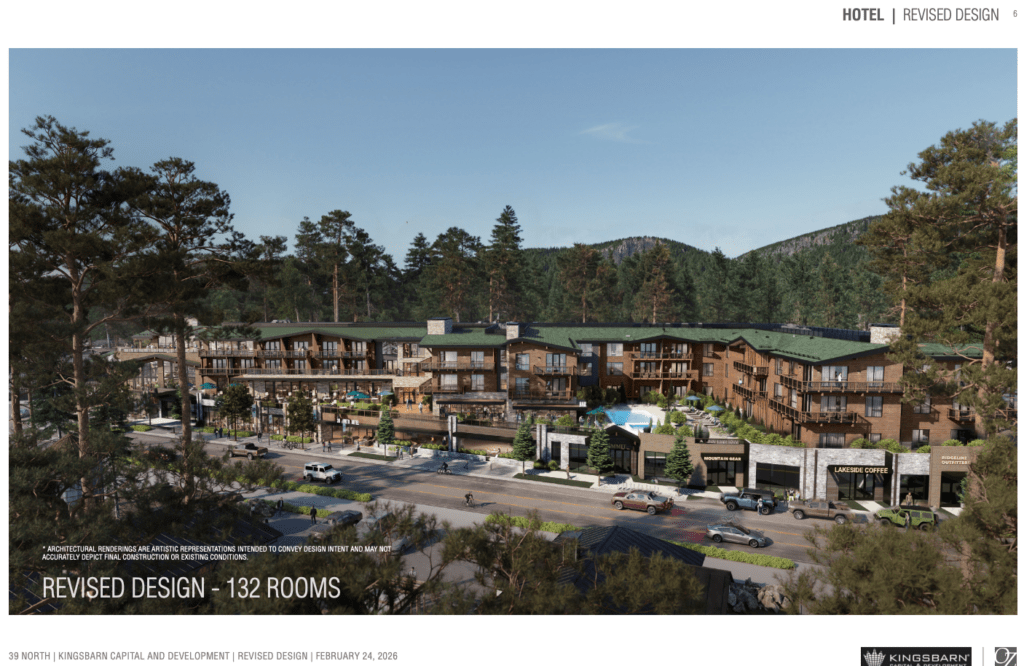
Rendering showing the proposed commercial frontage along North Lake Boulevard.
4 — What Would It Feel Like to Live Here?
When the committee turned to the achievable housing component, the discussion shifted from visitor activity and commercial uses to the everyday experience of residents.
Unlike the hotel and condo-hotel townhomes near the Raccoon Street roundabout, the achievable housing building is proposed on a separate parcel farther east along North Lake Boulevard near Chipmunk Street.
Housing Along the Highway 28 Corridor
During the discussion, several committee members focused on what it would feel like to live in the proposed units — particularly those located at the ground level along North Lake Boulevard.
One member described imagining “living in one of these units… on the ground level,” questioning whether it would be “an ideal living situation” given the building’s proximity to the roadway.
The housing site sits directly along Highway 28, a heavily traveled regional corridor. Members noted that units would face the street, raising concerns about noise, visibility, and day-to-day living conditions.
The discussion also pointed to specific site constraints shaping that condition. Development standards allow a front setback ranging from zero to five feet, limiting how far the building can be set back from the roadway.
In addition, members observed that a bus stop is located directly in front of the site, further concentrating activity along the frontage.
Together, these conditions prompted questions about how ground-floor units would function in practice for year-round residents.
Members raised concerns about:
• proximity to a high-traffic roadway
• noise and privacy at the ground level
• units directly facing North Lake Boulevard
• the overall suitability of the location for residential use
At one point, a member summarized the concern directly, noting that “it’s not ideal” to have units facing such a busy street.
Housing Within the Larger Development
The achievable housing building is proposed as part of the same overall redevelopment project that includes the hotel and condo-hotel townhomes.
During the discussion, members also noted that — unlike other parts of the project — this building does not include ground-floor commercial uses.
That distinction prompted questions about how the building contributes to the mixed-use environment envisioned for the Town Center district.
Several members suggested that introducing small-scale retail or commercial uses — such as coffee shops or neighborhood-serving spaces — could change how the building relates to the street and how the space is experienced by both residents and the broader community.
The discussion also surfaced a more direct uncertainty about the residential component itself. In considering the location and configuration of the units, one member questioned who would ultimately choose to live in that setting.
Taken together, the conversation highlighted not only the physical conditions facing the housing site, but also how those conditions align with the broader goal of creating livable, integrated housing within the Town Center environment.
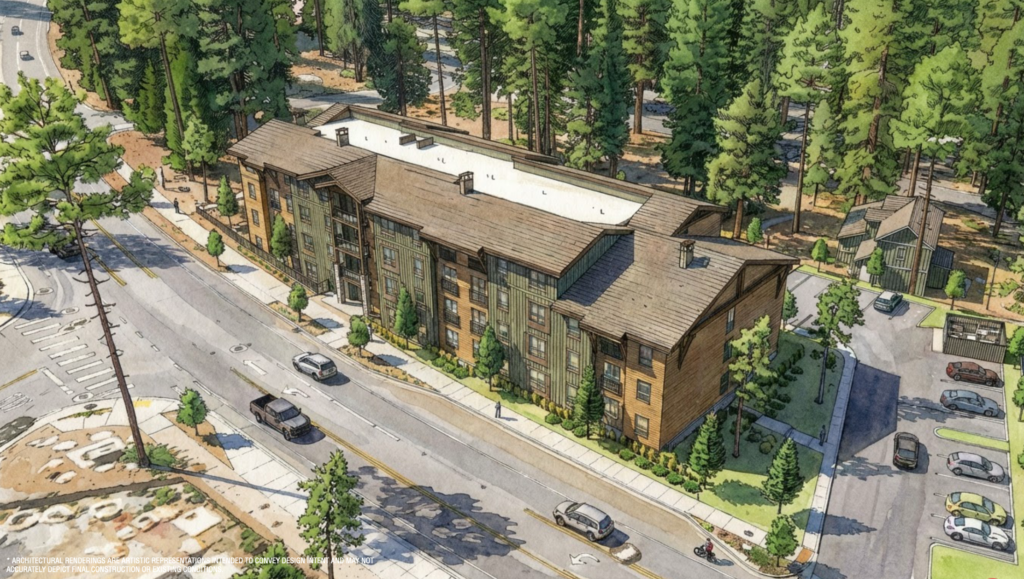
Concept rendering of the proposed achievable housing building near North Lake Boulevard and Chipmunk Street.
5 — How Does the Condo-Hotel Model Function?
As the conversation returned to the portion of the project along Salmon Avenue, committee members examined another defining feature of the proposal: the condo-hotel townhomes.
A Hybrid Ownership Model
The townhomes introduce a hybrid structure that blends private ownership with visitor accommodations.
Under the proposed model, units would be individually owned, but also participate in a hotel-style rental program. Owners would be permitted to occupy their units for a limited number of days each year, with the remaining time made available for visitor use through the hotel.
This arrangement is intended to ensure that units remain active rather than sitting vacant, while still functioning as part of the project’s overall visitor accommodation program.
What Gets Built — and When
During the presentation, another detail of the proposal drew attention from the committee: the townhomes are not designed as a single fixed building type.
Instead, units are proposed with multiple configuration options. As described during the meeting, townhomes may be constructed as either three-story or four-story units, with the final configuration determined by the individual buyer.
That flexibility introduces a layer of uncertainty into how the project will ultimately be built and experienced.
Rather than a single, consistent building form, the final outcome could vary depending on which options are selected over time — influencing how the development reads from the street and how it relates to surrounding properties.
Scale, Height, and Neighborhood Context
Committee members raised questions about how the townhomes would be perceived at the pedestrian level and in relation to nearby residential areas.
Some members suggested that lower building forms — such as two- or three-story units — may be more consistent with the surrounding context, noting concerns about height, massing, and how the buildings would feel from adjacent streets.
Others pointed to the overall scale of the development, describing portions of the townhome area as “too massive” or “too tall,” and raising concerns about potential impacts on neighboring properties, including access to sunlight.
Because the townhomes combine a hybrid ownership model with flexible building configurations, the discussion highlighted both how the units function and how their final form may evolve over time.
Taken together, those factors prompted broader questions about how the townhome portion of the project will ultimately fit within the Town Center environment — both in its day-to-day use and in its built form.
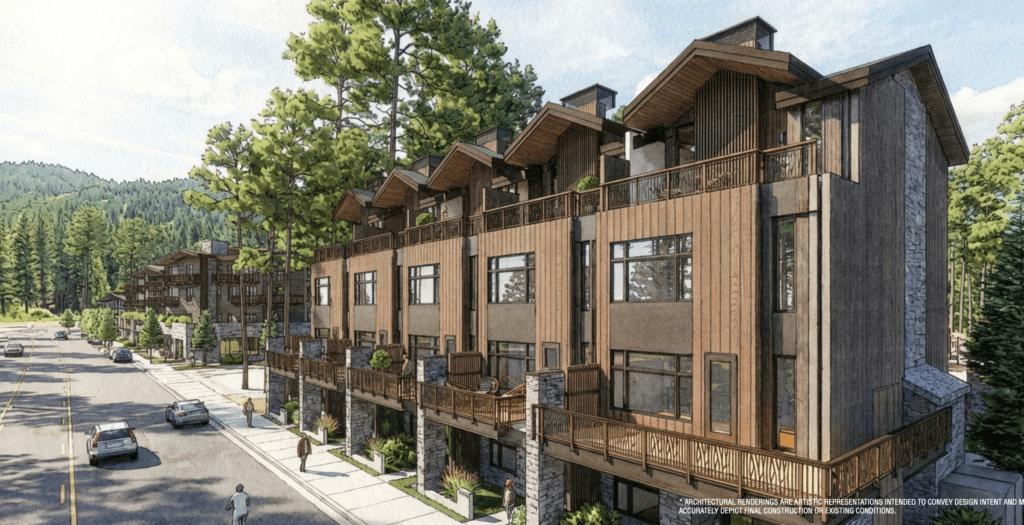
Rendering of the proposed condo-hotel townhomes along North Lake Boulevard.
6 — How Will Sun and Winter Conditions Shape the Block?
Beyond architecture and land use, the committee also examined how the project’s scale might influence conditions along surrounding streets throughout the year — particularly during winter months.
Sunlight and Building Mass
Members discussed how the length and height of the proposed hotel building could affect how sunlight reaches nearby sidewalks, courtyards, and pedestrian areas.
In the Town Center planning framework, building length and massing are tied not only to visual scale, but also to access to light and air at the street level.
As presented, the hotel extends roughly 445 feet along North Lake Boulevard. Members considered how that continuous building length — without significant breaks — could influence how sunlight reaches areas behind the building, particularly during winter when the sun sits lower in the sky.
Winter Conditions and Everyday Activity
The discussion became more specific when members turned to conditions along Salmon Avenue.
One member noted that “the back of this… is going to be an ice rink,” pointing to concerns that limited winter sunlight could prevent snow and ice from melting along the street.
The comment reflected a broader concern about how building mass and orientation could shape real-world conditions on the ground.
In mountain communities like Kings Beach, access to sunlight plays a critical role in how streets function during winter. Areas that remain shaded for long periods can stay colder, icy, and more difficult to navigate.
Members noted that these conditions could be particularly important along Salmon Avenue, where the Kings Beach Post Office is located and where pedestrian activity — including daily trips for mail and services — occurs year-round.
The discussion highlighted that building scale can influence more than architectural character. It can shape how streets function in winter conditions, affecting pedestrian access, safety, and the day-to-day experience of the surrounding community.
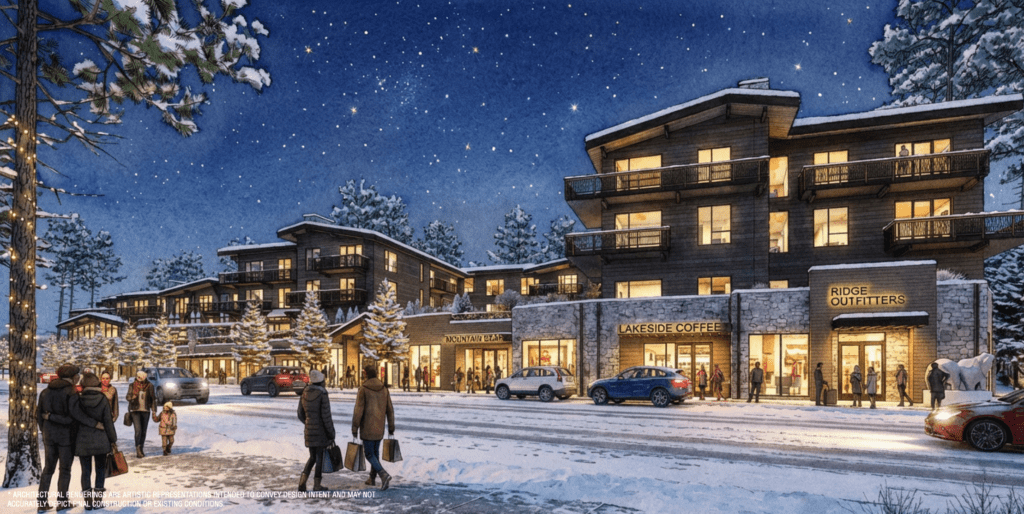
Diagram illustrating potential winter conditions associated with the proposed hotel building.
7 — How Do Town Center Development Standards Apply to This Project?
Beyond questions of architecture and livability, the discussion also returned to a central regulatory issue: how Town Center development standards apply to a project of this scale — and how those standards are interpreted in practice.
Building Length — and the Conditions Attached
The Tahoe Basin Area Plan establishes a base building-length standard of approximately 250 feet within Town Center subdistricts.
Under certain conditions, buildings may extend beyond that length — up to 500 feet — but that additional length is tied to specific design requirements intended to preserve the Town Center’s village-scale character.
As discussed during the meeting, those conditions include measures such as breaking the building mass and incorporating reductions in height within extended building lengths to maintain access to light, air, and open space.
With the proposed hotel extending roughly 445 feet, the committee examined how the project aligns with those standards — and whether the design strategies presented achieve the intended effect.
The design team pointed to façade articulation, stepped volumes, and architectural variation as ways to reduce the perceived scale of the building.
The discussion, however, focused on whether those approaches function as visual treatments — or whether they meet the underlying purpose of the standard, which is to physically break down building mass and preserve environmental conditions at the street level.
Variances and How Standards Are Applied
The conversation also raised questions about how flexibility within development standards is applied.
During the discussion, one committee member remarked that they had “never been allowed to ask for a variance on a raw piece of ground,” reflecting on how variances are typically tied to unique physical constraints of a site rather than design choices.
The comment emerged in the context of how the project addresses building length and massing requirements, highlighting a broader question about when deviations from established standards are appropriate — and how those decisions are justified.
Evaluating the Project Across Two Sites
County staff also explained that the project is being reviewed as a single mixed-use development spanning two separate parcels, rather than as two independent projects.
That interpretation allows development standards — including housing integration and mixed-use requirements — to be evaluated collectively across the full proposal.
Committee members considered how that approach relates to the Town Center vision, which emphasizes a pattern of multiple buildings, connected streets, and distributed activity, rather than a single large-scale development occupying a significant portion of a central block.
Why Interpretation Matters
Taken together, these discussions highlighted that the evaluation of the project depends not only on the written standards themselves, but on how those standards are interpreted and applied.
This question becomes particularly relevant as the project moves forward through the approval process.
During the February 24 meeting, County staff indicated that the project may proceed through Tahoe Basin Area Plan (TBAP) conformity review, potentially supported by an addendum to an existing environmental document.
Under that pathway, the determination of whether the project conforms to adopted standards plays a central role in how the project is evaluated.
In that context, how standards related to building length, massing, mixed-use configuration, and site organization are interpreted may directly influence whether the proposal is ultimately found consistent with the Town Center framework.
Hotel diagram illustrating the full length of the proposed hotel building.
8 — What Did the Committee Ultimately Clarify?
As the three-hour meeting drew to a close, the committee stepped back from individual design topics and reflected on the proposal more broadly.
Over the course of the discussion, members had examined the project through several lenses:
- building scale and block length
- site organization and circulation
- street-level activity
- housing livability
- hybrid ownership models
- environmental conditions
- interpretation of development standards
The meeting did not produce final conclusions about the project itself. Instead, it clarified the questions that remain open as the proposal continues through the review process.
Throughout the discussion, the tone of the meeting remained analytical rather than adversarial.
Committee members did not frame their questions as opposition to the project itself, but rather as an effort to understand how a development of this scale performs within the Town Center planning framework guiding redevelopment in Kings Beach.
Many of the questions focused less on individual architectural details and more on how the project would function over time as part of the broader streetscape and neighborhood environment.
Projects of this scale often evolve through multiple rounds of design review before formal approvals are considered, and several members suggested that aspects of the proposal may continue to change as the project moves forward.
In that sense, the meeting revealed less about final answers than about the questions that may shape how the proposal evolves in the months ahead.
The Decision Path Ahead
While the February 24 meeting focused primarily on design considerations, the project is also approaching an important procedural milestone.
Under the Fourth Amendment to the development agreement between Placer County and the developer, environmental documentation for the project is expected to be submitted for review in March 2026. Earlier versions of the development agreement anticipated submission of an Environmental Impact Report / Environmental Impact Statement (EIR/EIS) as part of that milestone.
During the February meeting, however, County staff indicated that the project may instead proceed through Tahoe Basin Area Plan (TBAP) conformity review, potentially supported by an addendum to an existing environmental document.
That distinction matters because the two approaches evaluate projects differently.
A traditional project-level environmental review typically involves a broader environmental review process. A TBAP conformity review, by contrast, focuses on whether a proposal complies with development standards and policies already analyzed through the adopted area plan.
If the project is found to conform to those standards — potentially with adjustments approved through the design review process — environmental documentation may be completed through an addendum to the existing environmental analysis rather than a new full environmental review.
The specific review pathway will ultimately be determined through the County’s entitlement process as the project moves forward.
What This Moment Reveals
Taken together, the February 24 design review offered one of the clearest public looks yet at how the 39° North proposal performs when examined against the planning framework guiding redevelopment in Kings Beach.
Committee members explored the project from multiple perspectives — building scale, site organization, street activity, housing livability, environmental conditions, and the interpretation of development standards.
Rather than producing a verdict about the project itself, the meeting revealed how the proposal is currently being tested against the principles that have shaped the Town Center vision for more than a decade.
Town centers rarely emerge from a single project.
They evolve through many decisions over time — decisions about buildings, public space, housing, circulation, and how people experience the street.
The February 24 meeting offered a rare public window into how those decisions are examined in real time — and how the Town Center vision is ultimately tested when redevelopment proposals move from planning documents into actual projects.
Leave a Reply