AB 2679 starts with a straightforward goal: make recreation access safer.
People should not have to park dangerously along Tahoe highways or walk through active traffic to reach beaches, trails and public lands. Assemblymember Heather Hadwick, TRPA and supporters have made a credible case that California needs clearer authority to address those conditions. At a July 1 Senate hearing, TRPA described AB 2679 as a focused way to improve recreation access, parking, transit and pedestrian safety on California’s side of Tahoe. (Digital Democracy | CalMatters)
The bill is already well along in Sacramento. The June 28 Senate Natural Resources and Water analysis lists support from TRPA, El Dorado County, the California Tahoe Alliance and the League to Save Lake Tahoe.
AB 2679 would create authority on designated portions of Routes 28, 50 and 89 on California’s side of Tahoe. From a North Tahoe lens, what I have seen much less of is a broader public conversation about what decision-makers should understand as they shape this new authority and Fund for safe recreation access.
As amended July 9, the bill would create the Tahoe Safe Recreation Access Fund — before most individual parking projects are known. The bill does not tell us today where later parking might go, how large a facility might be, what it might cost or how much parking-fee revenue it might produce. (California Legislative Information)
North Tahoe now has a visible public forum for that conversation. The North Tahoe Public Utility District has scheduled a 4 p.m. Aug. 11 public discussion on “Tahoe Basin Peak Demand Management and Assembly Bill 2679,” two days before the Senate Appropriations suspense vote.(NTPUD Aug. 11 agenda)
The legislative conversation is already well underway. Here in North Tahoe, the public conversation about what this new authority and Fund should understand about the roads, services and communities around recreation access is only now becoming more visible.
For me, that is also the opportunity. Creating new Tahoe-specific authority and funding is significant, and Tahoe communities do not have to have every answer before asking what more that framework should recognize or accomplish. If there are things California should understand about the communities supporting recreation access, this is the time to start that conversation.
If California is creating new Tahoe-specific authority and funding, what should that framework understand about the communities and public systems that make safe recreation access possible — and that people here depend on every day?
What AB 2679 would create
AB 2679 would allow Caltrans to work with state agencies, local governments or the Tahoe Transportation District on unsafe parking, pedestrian safety and recreation access. On state rights-of-way or other state-owned land, that could include public parking, parking fees, transit facilities and pedestrian connections. Parking-fee revenue would go to the Tahoe Safe Recreation Access Fund and, upon legislative appropriation, could support parking, transit, pedestrian pathways and related facilities and operations. (California Legislative Information)
The bill does not tie parking-fee revenue back to the specific location or community where it was collected. Once deposited in the Tahoe Safe Recreation Access Fund, the money would be available, upon legislative appropriation, for the bill’s eligible purposes within the Tahoe corridor.
That raises another framework question: if one Tahoe community hosts recreation access or parking that generates revenue — and also carries some of the surrounding traffic, transit, public-service or operational demand — how should that relationship be recognized?
Nevada helps explain why AB 2679 seeks comparable authority for California. The bill itself points to Nevada’s 2025 law as part of the rationale for giving California equivalent statutory tools. But comparable authority does not necessarily require California to shape its framework in exactly the same way. California still has to decide what its new authority and Fund should understand about Tahoe’s different roads, seasons, public systems and communities.
From my conversation with the author’s office, I understood that Caltrans would still need to work through where projects might go, whether they are feasible, what they might cost and what parking fees might bring in as the program develops.
The funding context matters too. At the July 1 hearing, Senator John Laird noted that some transportation funding is tied to resident population even though places such as Tahoe may serve far more people during tourism periods. (Digital Democracy | CalMatters)
AB 2679 does not solve that larger funding problem. But it would create a fund for future parking-fee revenue in a place where the number of permanent residents does not tell the whole story of how many people use the transportation system.
In a July 20 Tahoe TAP podcast interview, Placer County Supervisor Cindy Gustafson was asked to look five years ahead and, with a “magic wand,” imagine better Tahoe transportation. Her “dream” included some form of user fee for people entering the Basin, “major parking structures or garages,” and free transportation from there. She also raised fairness for residents and commuting workers and the difficulty of making a bi-state approach work.
It was a hypothetical, not a formal plan or an AB 2679 proposal. Laird’s point describes the transportation demand Tahoe already serves; Gustafson’s answer looks ahead to how user contribution, parking, transit and fairness might someday fit together.
Together, those perspectives widen the question beyond a single parking location. Whatever safe-recreation-access system develops will operate on roads that are also the everyday transportation system for Tahoe communities.
How should safe recreation access work on California’s side of Tahoe — not only one destination or one hazard at a time, but across connected roads and changing conditions?
In Tahoe, the road to recreation is also somebody’s road home
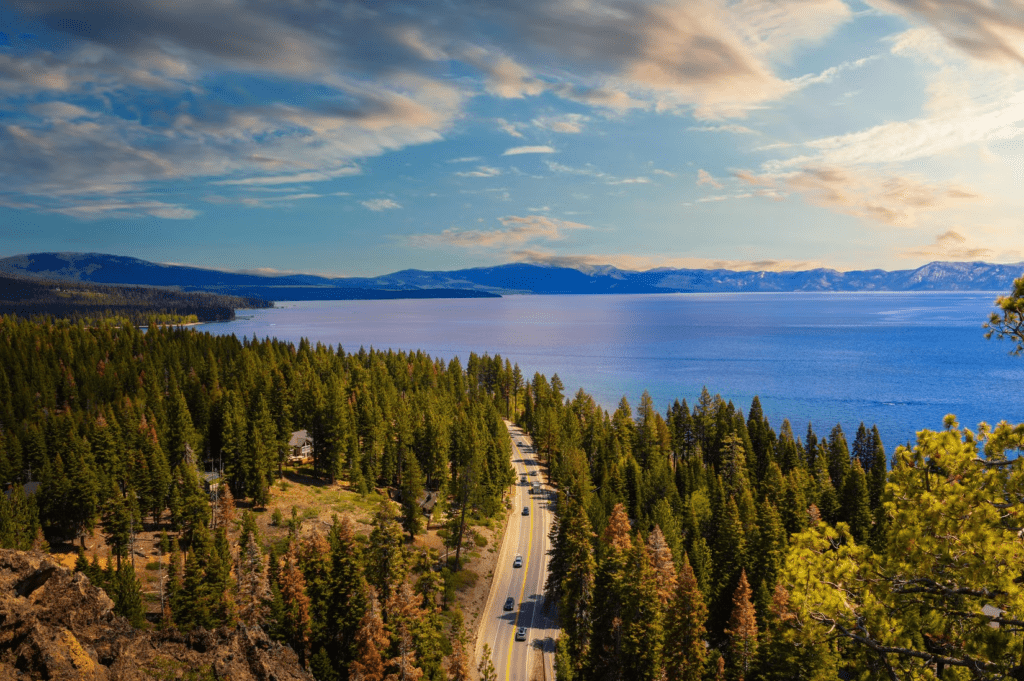
From Kings Beach through Tahoe City and down Route 89 along the West Shore, the state highway is not simply the route to recreation.
It is also somebody’s road home.
In the same few minutes, Route 28 or Route 89 may carry a TART bus, a worker headed to a job, a resident turning into a driveway, a delivery truck, visitors looking for recreation access and an emergency vehicle that still has to get through. In winter, snowbanks and plows narrow the same roads.
That is the nexus:
Safe recreation access is one problem. Sustaining the communities and infrastructure that make that access possible is a related but broader problem.
When recreation demand rises, the roads still have to work. So do transit, emergency response, snow operations, sanitation, utilities and the workers who keep those services running.
That is one practical way to think about carrying capacity in daily Tahoe life: what can the roads, communities and public systems keep doing while recreation demand is also being served?
July Fourth shows why access conditions may reach beyond the destination
July 4, 2026, was not an AB 2679 event. But it gives North Tahoe a recent example of what can happen when recreation demand, changing conditions and community systems meet on the same peak day.
For me, July Fourth made that question less abstract.
After problems involving large groups, drinking, litter and neighborhood traffic around Lake Forest, several beaches were closed at 4 p.m. 2News separately reported heavy activity in Kings Beach afterward. The reporting does not tell us precisely how much of what Kings Beach experienced resulted from those closures or what would have happened there anyway. (2 News Nevada)
A July 8 resident petition asked for an after-action review and a more coordinated approach to beach access, parking, transit, traffic flow and crowd movement. (Change.org)
I did not locate a public after-action account that brings together what agencies concluded, what gaps they identified or what will be carried forward before the next peak recreation day.
Emerald Bay and Eagle Falls show why California needs to correct specific recreation-access hazards. July Fourth raises a different question: what happens across the connected system when conditions change during peak demand? It also raises the practical value of being better prepared when roads, parking, transit and communities are under pressure at the same time.
And the question is bigger than one holiday. Bluebird ski weekends after major storms, road closures, constrained parking and other changing conditions can put different parts of the same Tahoe road system under pressure.
The point is not to manage recreation like an emergency. It is to ask whether predictable peak conditions deserve some of the same habit of thinking ahead across connected roads before pressure arrives.
Tahoe already knows the value of thinking ahead across limited roads
Tahoe already knows how to think ahead across limited, connected roads when conditions can change quickly. Recreation access is different from evacuation, but California does not have to invent the habit of agencies working together across those roads from scratch. (Lake Tahoe Regional Evacuation Plan)
Could some of that anticipatory thinking help agencies prepare for predictable peak recreation conditions too?
That question also depends on seeing how one road or destination connects to another. Placer County already looks at the roads this way. AB 2679 covers designated portions of Routes 28, 50 and 89, not Route 267. Yet Placer plans 28, 89 and 267 as connected roads serving people who recreate, work and live in North Lake Tahoe; Route 89 itself carries substantial community and ski/resort recreation traffic. (Placer County – Resort Triangle Transportation Plan.)
The statutory boundary may stop at a route designation. Tahoe travel does not.
What should the new authority and funding leave Tahoe better able to do?
Parking, transit, pedestrian pathways and the connections among them are the obvious center of the new Fund.
But Tahoe is not starting from zero. Agencies already operate transit, study corridors and run pilots. At Eagle Falls, a Tahoe Transportation District pilot recorded 20,513 pedestrian crossings over 32 days and eight near misses. It initially flagged 759 events as possible wrong-way driving; later video review showed U-turns or vehicles crossing the double yellow line around traffic. (U.S. DOT Implementation Report)
The initial data made the condition visible. Video review changed the interpretation.
TTD’s final report says keeping this kind of work useful beyond a pilot takes ongoing funding, local technical capacity and partnerships. It also discusses before-and-after evaluation and sharing useful information so later work can build on what was learned. (U.S. DOT Implementation Report)
A pilot can end, but Tahoe still has to make the next safe-access decision.
So the question is not only what to build. It is also what happens to what Tahoe learns.
Could recreation-access work under this framework also leave Tahoe better informed — by showing what changed, preserving useful findings, helping agencies prepare as conditions change and carrying those lessons into later decisions?
The opportunity is to leave Tahoe not only with an improvement, but better able to make the next safe-access choice when conditions change.
What Tahoe learns from safe-access work is one question. What the new Fund should pay for — and what may still matter to a decision even when the Fund does not pay for it — is another.
What should still matter beyond the Fund?
A concern does not necessarily have to become an eligible Fund expense in order to matter to a decision.
The Fund can stay focused on parking, transit and pedestrian access. But a larger access decision may still change who has to operate something, manage traffic or provide public services — or it may reduce an existing burden.
The Fund does not have to pay for those things for them to matter.
Tahoe SPARK, which has proposed broader amendments to AB 2679, takes a wider approach, bringing carrying capacity and community resilience — including emergency response, utilities, public services, resident access and spillover effects — more directly into the statute. AB 2679 takes a more focused approach.
There is room between those approaches. A focused Fund and a broader view of Tahoe conditions are not necessarily opposites: something can matter to a recreation-access decision even when another agency, program or funding source remains responsible for it.
That distinction becomes more consequential as the choices grow larger and harder to reverse.
As choices get larger, what else should matter?
The Senate fiscal analysis says capital costs, significant ongoing costs and parking-fee revenue remain uncertain. AB 2679 also defines public parking broadly enough to include surface lots, decks, garages and parking structures, although it approves none of those specific projects today. (California Legislative Information) (California Legislative Information)
That uncertainty does not mean future projects are infeasible. It means the fiscal picture is not yet settled. Correcting a dangerous shoulder and making a large, long-lived recreation-access investment are not the same kind of decision. A sign, seasonal restriction or pilot can be adjusted more easily than infrastructure intended to operate for decades.
As choices become larger and harder to reverse, should California understand more before committing — including what Tahoe’s roads, infrastructure, public services and communities are already carrying or may be asked to carry?
For transparency, I filed an individual Oppose Unless Amended position on Aug. 2. My filing offers one focused response: keep immediate and routine safety work moving; begin with information California agencies already hold; carry useful findings and before-and-after results into later decisions; publicly account for Fund revenue, spending and outcomes; and ask more before major, long-lived commitments. Tahoe SPARK proposes a broader statutory approach centered more explicitly on carrying capacity and community resilience. Others may believe existing project review and regional planning are sufficient.
The difference is where each approach draws the line: what belongs in the bill now, what can be learned as work proceeds, and what existing project or regional review can reasonably handle later.
Those are the kinds of choices Tahoe communities can help illuminate. The question is not whether every community reaches the same answer, but whether people have a meaningful opportunity to show decision-makers how safe access interacts with the roads, services and communities around it while the framework is still being shaped.
What should California get right?
AB 2679 begins with a real need for safer recreation access.
Safe recreation access is one problem. Sustaining the communities and infrastructure that make that access possible is a related but broader problem.
California does not have to know every future parking or recreation-access project today. But it is deciding something important now: what this new Tahoe-specific authority and Fund will be, what they are intended to accomplish, and what they should recognize about the place in which they will operate.
That matters because recreation access does not operate separately from Tahoe communities. The same roads also carry residents, workers, transit, deliveries and emergency response. Those communities also depend on public services and infrastructure that must keep functioning while recreation demand is being served. And parking-fee revenue generated through this new authority would enter the Tahoe Safe Recreation Access Fund rather than automatically return to the particular community where it was collected.
So the question is not only what future projects may eventually be developed. It is what California should ask of the authority and funding framework it is creating now.
Nevada helps explain why California is seeking comparable recreation-access tools. But California still has an opportunity to shape its own approach around the conditions on its side of Tahoe.
That is also where I see an opportunity in AB 2679. This is not only a question of whether California should have comparable recreation-access authority. It is an opportunity to decide what a California-side recreation-access framework should be, and what it should recognize about the communities and public systems that make safe access possible. Individual destination safety may be the starting point, but it does not have to be the end of the conversation.
What should California make sure this new authority and Fund recognize about the roads, services and communities that make safe recreation access possible — and that people here depend on every day?
As choices become larger, longer-lived and harder to reverse, those questions become even more consequential. But they begin earlier, with the framework California is creating now.
The state legislative process is already moving. The community conversation about safer recreation access on California’s side of Tahoe does not have to wait for the first project.
From North Tahoe, what do we want California — and the agencies that will put this new authority and Fund into practice — to understand while there is still time to shape them?
How to participate before the Aug. 13 vote
The North Tahoe Public Utility District has scheduled a public discussion of “Tahoe Basin Peak Demand Management and Assembly Bill 2679” at 4 p.m. Aug. 11 at the North Tahoe Event Center. The agenda also provides a remote livestream for that discussion. (NTPUD Aug. 11 agenda)
AB 2679 is listed for the Senate Appropriations Committee’s Aug. 13 suspense hearing, designated “for vote only.” (Senate Appropriations Committee)
If you want to weigh in, three questions from this article may be useful:
- How should safe recreation access work across California’s side of Tahoe, including connected roads and changing conditions?
- What should the Tahoe Safe Recreation Access Fund leave Tahoe better able to do?
- Before larger, harder-to-reverse safe-access choices are made, what should decision-makers understand about the roads, services and communities that make that access possible?
You can support the bill, oppose it, or ask for amendments.
The Senate Appropriations Committee says it has no formal deadline for position letters, but Aug. 13 is the next decision point. Letters submitted to the committee are retained as part of its legislative record. (Senate Appropriations Committee — Position Letters)
Position-letter resources
Readers taking any position can submit a letter through the official California Legislature Position Letter Portal.
If your position is Oppose Unless Amended, Tahoe SPARK has also prepared an Tahoe SPARK Example Position Letter, Tahoe SPARK Proposed Amendments, and a step-by-step guide for submitting through the Legislature portal.


Leave a Reply