Placer County is asking California to reconsider Kings Beach Census Tract 06061020107 for Opportunity Zone 2.0, a federal program that offers tax benefits for qualifying private investment in designated low-income census tracts.
The Board of Supervisors voted Tuesday to support that reconsideration after the California Department of Finance initially did not advance the Kings Beach tract from “eligible” to “recommended.” The item had been on the consent agenda. Supervisor Cindy Gustafson said there had been a public request for discussion, so she asked that it be pulled that morning.
What followed was more than half an hour of questions and public comment about investment, redevelopment, workforce housing and the difficult economics of getting projects built in Tahoe.
Gloria Stearns, Placer County’s Economic Development and Housing Manager, described Opportunity Zones as a “rarely used economic incentive” that gives qualifying investments access to federal tax benefits. She said her department believes the program “may be a useful tool for the area.”
Gustafson focused early on what designation would — and would not — do. She described it as a funding mechanism and asked staff to confirm that it would not change land-use zoning or approve a particular project. Staff agreed.
Placer’s written application provides more detail about how the County presented the opportunity to the State. It says adding Opportunity Zone 2.0 to the existing North Lake Tahoe Economic Development Incentive Program could be “very advantageous” for qualifying projects “to help make them feasible,” and says the County would promote the tool for private investment if Kings Beach is selected.
Two proposed projects are directly part of that application. When the State asked whether the tract included “shovel-ready” sites, Placer answered yes, listing Kings Beach Center — a 16-parcel mixed-use “39N proposal” — and Eastern Gateway — a 10-parcel workforce-housing “39N proposal.”
After public comment Tuesday, Stearns added another piece. She said the qualifying projects were what “allowed us to even apply.” She also made clear that the Opportunity Zone action did not mean either project was moving forward, signal Board support for them or commit the Board to anything related to them.
Those projects helped support Placer’s application. The Opportunity Zone itself would apply to the broader census tract.
The application also points to roughly $50 million already invested in the Kings Beach Commercial Core Improvement Project, along with other existing public and regional investment.
Why Kings Beach?
Supervisor Anthony DeMattei raised one of the most basic questions of the morning. He said he had toured Opportunity Zones created under the first federal program and remembered places that appeared considerably more distressed and abandoned.
“They sure don’t look like Kings Beach,” he said.
Staff explained that Placer County did not determine which census tracts met the federal eligibility criteria. Kings Beach was on the eligible list available for the County to nominate.
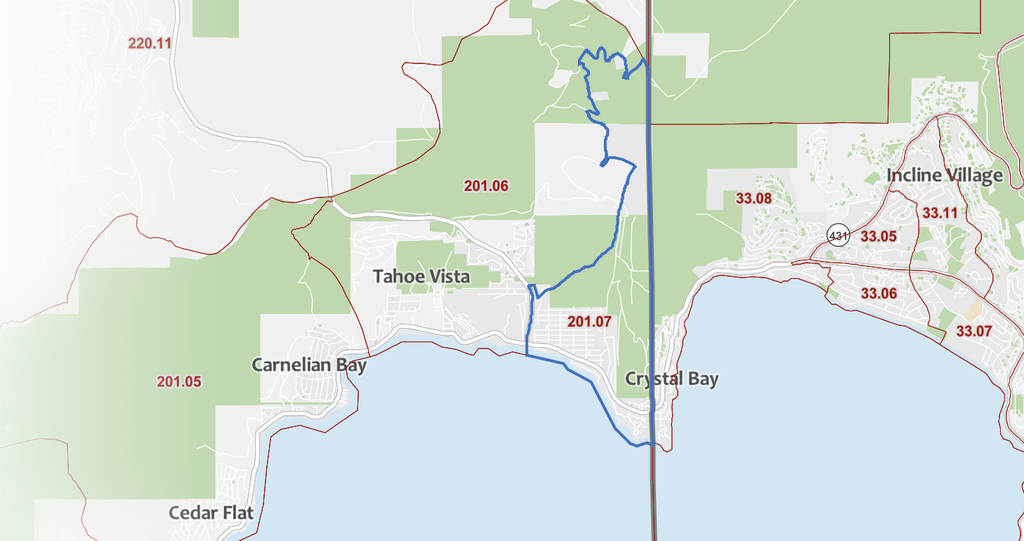
The numbers help explain some of the disconnect. Under Opportunity Zone 2.0, one path to eligibility is median family income below 70 percent of the applicable metropolitan or statewide median. Another begins with a poverty rate of at least 20 percent.
Current Census data for Tract 06061020107 estimate its poverty rate at about 6.6 percent — with a large margin of error — well below the 20 percent threshold. Kings Beach therefore appears to qualify through the family-income pathway rather than the poverty pathway.
Explore the U.S. Census Bureau profile for Census Tract 201.07
That helps explain how Kings Beach can meet the federal test without looking much like the Opportunity Zones DeMattei had visited. High property values and a visible resort economy do not necessarily tell the same story as the incomes of people living within the census tract.
Kings Beach resident Samir Tuma gave that contrast a local description. He called Tahoe a “dual economy” — the economy experienced by visitors and second homeowners alongside the very different economics experienced by many people who live and work here.
Tuma said he has spent four years trying to build four small workforce-housing units on a Kings Beach parcel.
“It doesn’t pencil,” he told the Board.
In plain language, the project does not make financial sense under its current cost-and-revenue equation. Tuma argued that an Opportunity Zone tax benefit could help bridge that gap.
Jim Kaplan, a longtime Kings Beach building owner and developer, widened that same feasibility problem beyond one small housing project. He pointed to aging and stalled properties and to public infrastructure already built in Kings Beach, arguing that additional outside capital could help redevelopment that has not moved.
Ann Nichols came from the opposite position. She asked the Board to vote no and raised concerns about higher land and housing prices, speculation and displacement. But in describing the economics behind those concerns, she also said Kings Beach projects “never pencil” because of Tahoe’s tourism economy and the constraints of building in the Basin.
The speakers were not agreeing about what Opportunity Zone designation would do or whether it was a good idea. From different directions, though, they were describing the same underlying difficulty: getting projects to work financially in Kings Beach can be hard.
Wayne Nader added the next piece. Investors, he said, will still ask: “Where’s my best return?”
That does not tell us what investors would choose. It does help frame what happens if the financial equation begins to change.
What happens if more begins to pencil?
Along Highway 28, the potential benefit is easy to picture. Kings Beach has already had major public investment in its commercial core while some aging properties and redevelopment sites have remained stalled. Additional private capital could help make redevelopment possible where the numbers have not worked before.
But the proposed Opportunity Zone is a census tract, not a redevelopment district along Highway 28.
Look uphill into the neighborhoods.
Opportunity Zone designation would not create new development rights there. Existing County and TRPA rules would still determine what can be built.
But those existing rules already allow more than what is visible on many properties today. Base standards in the Kings Beach Residential Subdistrict include one single-family dwelling per parcel and, where applicable and subject to other requirements, multifamily and employee housing at densities of up to 15 dwelling units per acre. Separate housing amendments adopted in 2025 provide additional flexibility for qualifying 100-percent deed-restricted affordable, moderate and achievable housing projects in areas already zoned for multifamily housing.
The physical pattern matters, too. The Area Plan describes the residential area uphill from Highway 28 as a grid originally divided into lots 125 feet deep and as narrow as 25 feet, with many lots 50 or 75 feet wide.
Picture a single-family home sitting on land made up of several of those original narrow lots.
Opportunity Zone designation would not give that property development rights it does not already have, and nothing guarantees redevelopment. But where additional development potential already exists, different economics can change how an owner, buyer or investor evaluates the land.
A property that has functioned as one home could, where the rules allow it, begin to pencil differently as a workforce-housing opportunity. That could address exactly the kind of feasibility problem Tuma described.
But the incentive does not reserve improved economics for workforce housing.
The rules may stay the same while the economics of using them change.
The geography matters on the benefit side, too. Housing built in Kings Beach may serve someone who works here, or it may help meet workforce needs elsewhere around North Tahoe. Commercial, recreation and visitor-serving investment located here can likewise support a broader regional economy.
Those can be real benefits, while the physical development still lands in Kings Beach, where it becomes part of the same neighborhoods, streets, infrastructure and public services used by the year-round community.
If changing economics make Kings Beach a more feasible place to locate solutions serving wider regional needs, it is worth watching what the community is being asked to carry — and what comes back to Kings Beach in return.
Success for Kings Beach
One workforce-housing project can make sense. So can the redevelopment of an aging commercial property or a new visitor-serving investment.
Kings Beach does not ultimately experience those decisions as separate applications. It experiences what they become together.
That is where capacity becomes useful. It does not mean declaring Kings Beach “full,” and it does not require finding one number that determines how much development is acceptable. It means being able to see what individual changes are adding up to while there is still time to understand them.
Kings Beach has tried to articulate a local direction before. But there is an important geographic distinction.
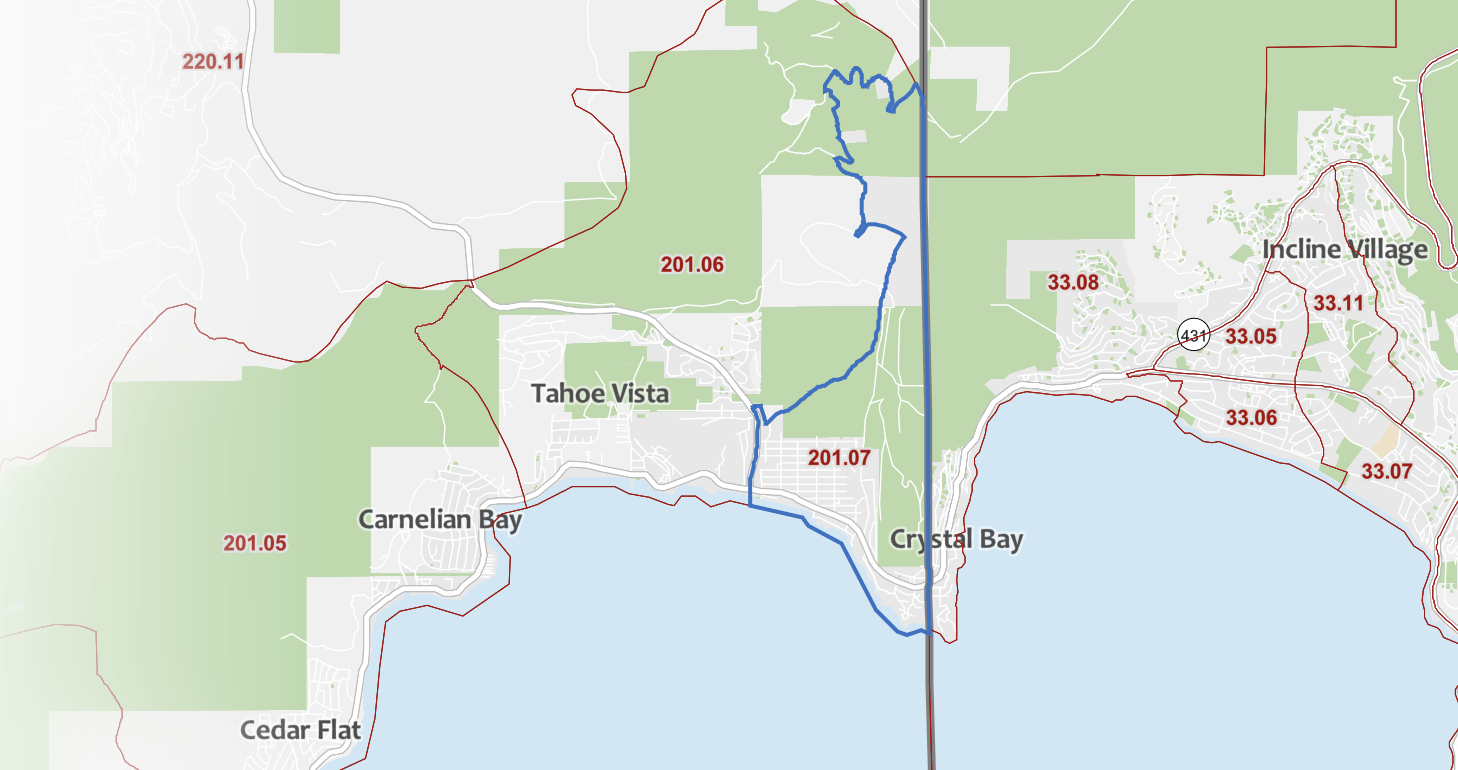
The 2013 Kings Beach Vision Plan says its study-area boundary was established to coincide with TRPA’s Kings Beach Town Center District. The proposed Opportunity Zone follows Census Tract 201.07 — a different and substantially broader geography.
Residential areas beyond the Vision Plan boundary are not without planning rules. They are governed by the broader Tahoe Basin Area Plan and applicable land-use and development standards.
But the difference between the two boundaries is worth seeing.
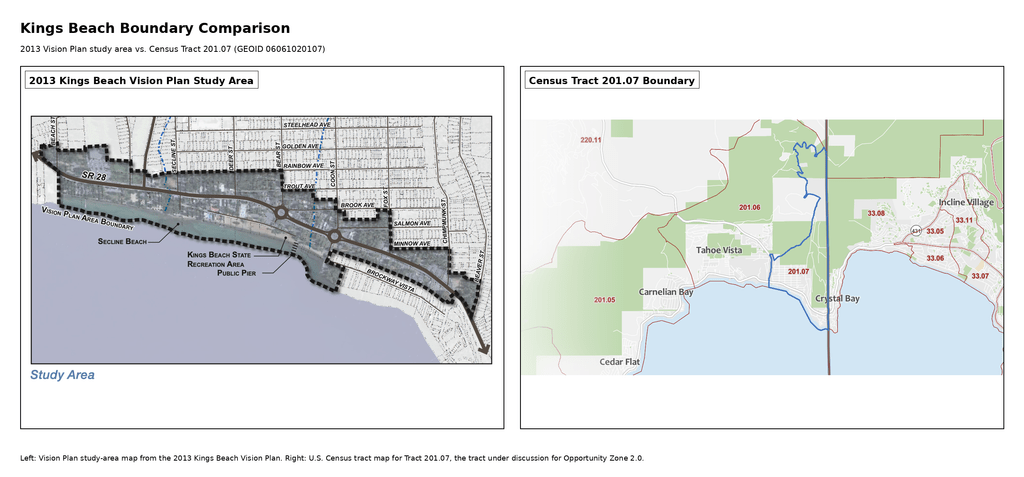
The Vision Plan includes the principle to “Establish Kings Beach as a recreation hub while maintaining diverse, friendly local neighborhoods.”
The Vision is conceptual, not today’s regulatory rulebook. And it does not cover the same geography as the proposed Opportunity Zone.
That leaves a practical reason to watch cumulative change across the broader community: individual investments may still be reviewed property by property, but Kings Beach will experience what they become together.
There is also a timing reason to think about that before dramatic physical change is visible.
Tahoe projects can still take years to review, finance and build. Opportunity Zone designation would not make those constraints disappear.
But investment decisions and construction do not necessarily move on the same clock.
Buildings may still take years. Investment decisions can happen much earlier.
Properties can change hands, parcels can be assembled and financing decisions can be made before anyone sees a finished building. That is not a prediction of a development rush. It is simply why the economics around future development can begin changing before the physical result is obvious.
The approval process may stay the same while the investment environment around it changes.
Tuesday’s resolution also directs County staff to work with regional stakeholders and community organizations to support “community-centered economic development initiatives within this tract.” What “community-centered” means here is still to be defined.
If Kings Beach is ultimately selected, success may not be measured only by how much capital arrives or how many more projects begin to pencil. It will also be visible in whether investments along Highway 28, uphill in the neighborhoods, and one property at a time are adding up to a Kings Beach the community itself recognizes as successful.
Share Your Voice
Tuesday’s vote did not designate Kings Beach as an Opportunity Zone. It supported Placer County’s request that California reconsider the tract.
California’s Opportunity Zone 2.0 public-comment period closes tonight, Aug. 28, at 11:59 p.m. The State says comments may be submitted on all eligible census tracts and may provide additional information, support or opposition.
California Opportunity Zone 2.0 public-comment information
What would success look like for Kings Beach?
Leave a Reply